The Geometry of Flow

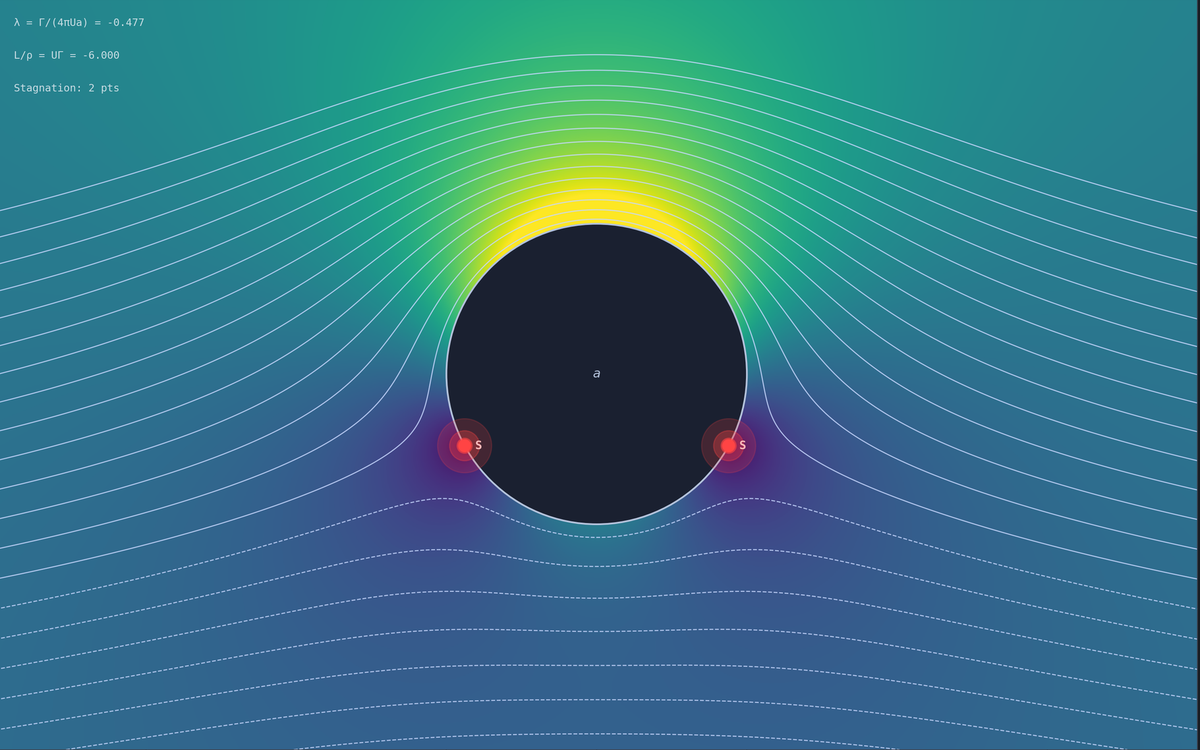
In CFD, and in mathematical models in general, certain principles or equations cannot be solved analytically.
Today we will explore one that can. We will work through some laws that all engineers might have already encountered across their studies, adding the circulation variable to the classic flow over a cylinder problem, gaining intuition by analysing the laws that make up this model, and finally manipulating the flow's properties to deepen that intuition.
The beauty of tying mathematical equations to real world physical behaviours, and vice versa, can be seen through this small example.
1. Problem Setup
A cylinder of radius $a$ is centred at the origin in a uniform stream of speed $U$ along the positive $x$-axis. The fluid is incompressible and irrotational outside the cylinder, so the velocity potential $\phi$ satisfies
We work with the complex potential $w(z) = \phi + i\psi$, analytic in $\mathbb{C}\setminus\{0\}$. Lines of constant $\psi$ are streamlines.
2. Building the Complex Potential
We build the solution by adding three known flows together — this works because Laplace's equation is linear, so any sum of solutions is itself a solution.
A uniform stream gives us $Uz$. To make the cylinder surface a streamline we add a doublet, which enforces the impermeability condition at $|z|=a$. Finally we add a free vortex — that single parameter $\Gamma$ is what introduces the circulation into the flow:
3. Velocity Field
The complex velocity $dw/dz$ gives:
In polar components at general $r$:
At the wall $r=a$ we have $u_r = 0$ (impenetrability) and $u_\theta\big|_{r=a} = -2U\sin\theta + \Gamma/(2\pi a)$.
4. Stagnation Points
Setting $u_\theta\big|_{r=a} = 0$ and defining $\lambda = \Gamma/(4\pi Ua)$:
For $|\lambda|>1$ the off-body point lies at:
5. Pressure and Lift
Bernoulli between the far field and the surface, with $\kappa = \Gamma/(2\pi Ua)$:
Integrating over the surface gives zero drag (d'Alembert's paradox) and:
6. Stream Function
Taking $\psi = \Im\, w$:
Level curves $\psi = c$ are streamlines. The colour map shows local speed magnitude; stagnation points are marked in red. Vary $\Gamma$ to watch the regimes in (5)–(6) unfold.
7. Beyond Potential Flow
The inviscid solution breaks down near the surface where viscosity dominates — real cylinders shed vortices (von Kármán street) and experience boundary-layer separation. Nevertheless, the potential flow result remains useful as a benchmark for CFD solvers in the outer inviscid region and as the outer solution driving the boundary-layer pressure gradient (favourable upstream, adverse downstream of the shoulder).